

Most leaders, if you ask them, will say they want their teams in the learning zone.
Stretching. Growing. Taking on challenges that are just beyond their current comfort level. Building capability through productive difficulty.
That’s the aspiration. The reality is usually different.
Most teams spend the majority of their time in one of two other places. Either they’re deep in the comfort zone — doing work that’s familiar, predictable, and well within their existing capability — or they’re pushed so far into the danger zone by pace, pressure, and unclear expectations that they live in a constant state of risk, and they’ve stopped being able to think clearly at all.
The learning zone is the narrow space between those two extremes. And most leaders, without realizing it, make it very hard for their teams to live there.
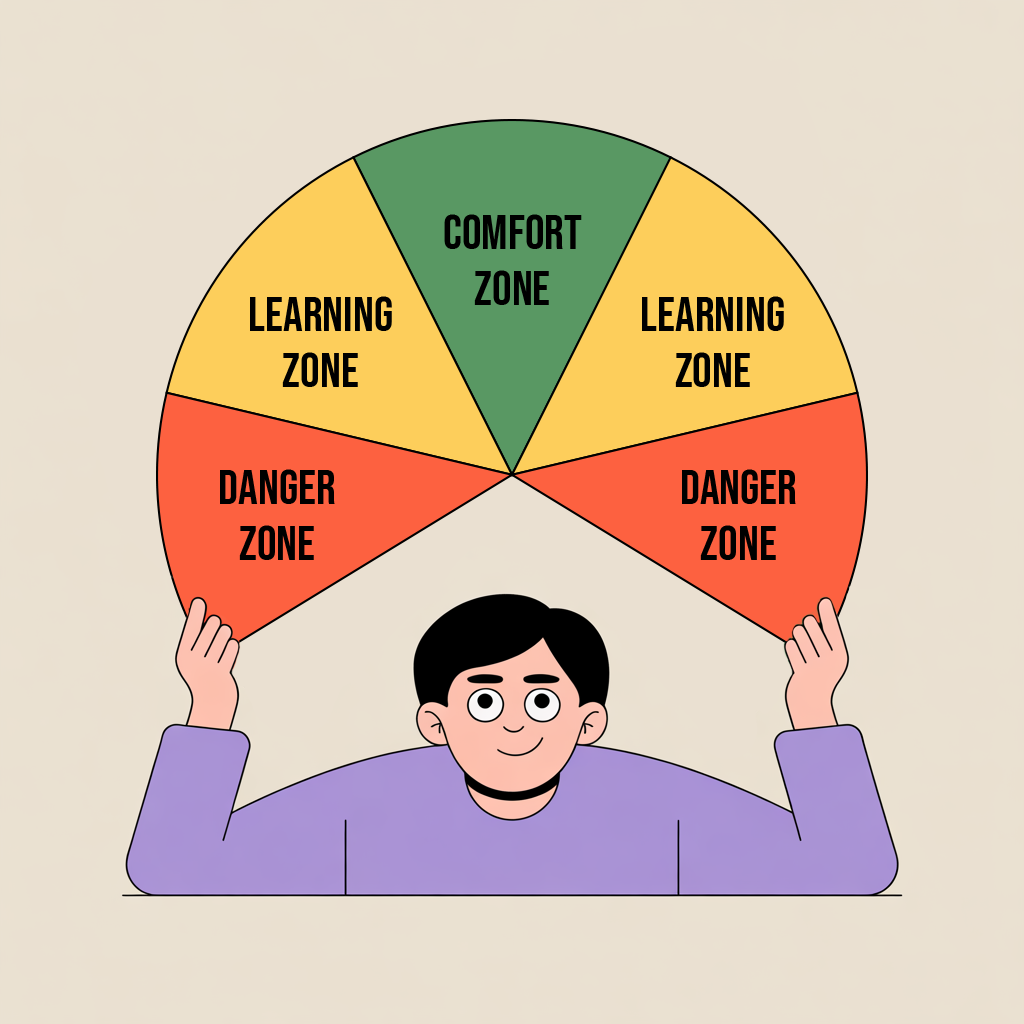
The comfort zone is easy to understand. When leaders over-direct, over-explain, and over-correct, they remove the conditions that require people to grow. People learn to wait for instructions. They stop solving problems independently because they’ve been trained — not maliciously, but consistently — that the leader will provide the answer. Work gets done, but capability doesn’t develop.
The danger zone is subtler and more damaging. It happens when the pace is too high, expectations are unclear, the stakes feel constantly elevated, and there’s no psychological safety for making mistakes. In the danger zone, people aren’t learning — they’re surviving. The cognitive load of operating under that kind of pressure leaves no room for the kind of reflection and experimentation that growth actually requires.
Think of it like a plant that’s outgrown its pot. It’s not going to thrive in those conditions. It’s not going to die immediately either. It’s just going to stop growing. And if nothing changes, it will eventually decline.
Manageable pacing is one of the most underrated leadership skills.
Not slow. Not unchallenging. But calibrated — designed to keep people in the productive discomfort of the learning zone rather than the numbing comfort of the familiar or the paralysis of the overwhelming.
This requires something that doesn’t come naturally to many leaders: paying attention to where their people actually are, not where they assume they are. It requires asking real questions and tolerating real answers. It requires adjusting pace and pressure based on what people can genuinely absorb, not just what the timeline demands.
And here’s the part that surprises most leaders when they first hear it.
When you get better at keeping your team in the learning zone — when you develop the skill of managing pace and creating the right conditions for growth — your own comfort zone expands too. You get more comfortable with uncertainty, with disagreement, with the productive friction of a team that’s actually thinking. You become a more capable leader not because you pushed yourself harder, but because you created an environment that required you to grow alongside the people you were leading.
The zone your team lives in is largely a product of the environment you create. And the environment you create is largely a product of who you’ve decided to be as a leader.
Which means the most important question isn’t which zone your team is in.
It’s what you’re willing to do — and stop doing — to help them live in the right one.
Photo by Julian Hochgesang on Unsplash
