
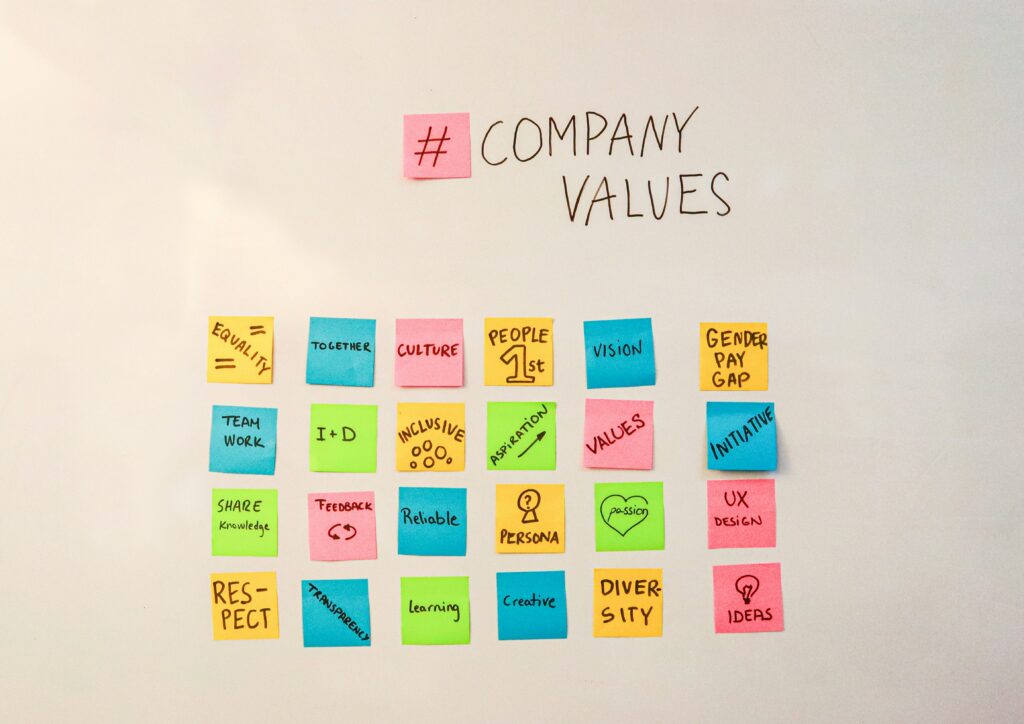
Most organizations are genuinely good at defining their values.
They do the work. They gather the right people, have the right conversations, and land on something that feels true — a set of values or a mission statement that actually captures something meaningful about who they want to be. Sometimes it ends up etched into the wall. Sometimes it becomes a card people carry in their pockets. Sometimes it lives in a beautifully designed deck that gets shared at an all-hands and never opened again.
And then something predictable happens.
Life takes over. There are clients to serve, problems to solve, decisions to make. The energy that went into creating the values gets redirected toward the actual work of running the organization. And the values — those carefully crafted, hard-won statements of identity and intention — start to function more like décor than direction.
The values that were supposed to shape accountability get reduced to enforcement. What was meant to be empowering becomes punitive.”
Writing values is not the same as living them. And the gap between the two is where most leadership cultures quietly fall apart.
I think about what happens to the people who volunteer to lead an organization. They pour themselves into it — their time, their energy, their best thinking. And when their tenure ends, a lot of them disappear entirely. Not because they stopped caring, but because they’re exhausted. The thought of staying engaged in any meaningful way after everything they just gave feels like more than they have left to offer.
Something similar happens with values work. The process of defining values is genuinely hard. It takes courage, vulnerability, and more organizational bandwidth than most people expect. And when it’s finally done, there’s an almost physical sense of release — we made it, we got through it, now we can move on.
The problem is that the values work isn’t done when the values are written. That’s when it starts.
Just because you’re capable of articulating a great value statement doesn’t mean you’re capable of living it — any more than the author of James Bond can actually live the life of James Bond just because he wrote it.
If you ask people in most organizations whether they’re experiencing the values their leaders profess to live by, the honest answer more often than not is no. Not because the leaders are dishonest. But because nobody went back to ask.
The fix isn’t complicated. It just requires a level of courage that’s rarer than it should be.
Jack Canfield, who co-wrote the Chicken Soup for the Soul series, has talked about a practice he and his wife used to maintain a strong marriage. At least weekly, they ask each other a simple question: on a scale of 1 to 10, how good was I as a husband today? How good was I as a wife? And if the answer was anything less than a 10, they’d ask: what would have made it a 10?
That’s an outrageously courageous act. And I don’t know that most leaders would be willing to be that vulnerable on a consistent basis — to ask whether they’re performing at a 10, and if not, why not, and what they’d need to do differently.
But imagine if they were. Imagine leaders asking their teams, on a regular cadence: are you experiencing the culture we said you’d have here? Are you seeing the values we said we live by? And then — crucially — being willing to hear the answer without getting defensive.
The goal isn’t perfection. The goal is the conversation. Because the gap between stated values and lived values doesn’t close on its own. It closes when someone has the courage to ask whether it’s there.
If you’re wondering whether your team is actually experiencing the culture you’re trying to build — or if you’d like some help having that conversation — I’d love to connect.
